Varifocal Displays Reduce the Impact of the Vergence-Accommodation Conflict on 3D Pointing Performance in Augmented Reality Systems







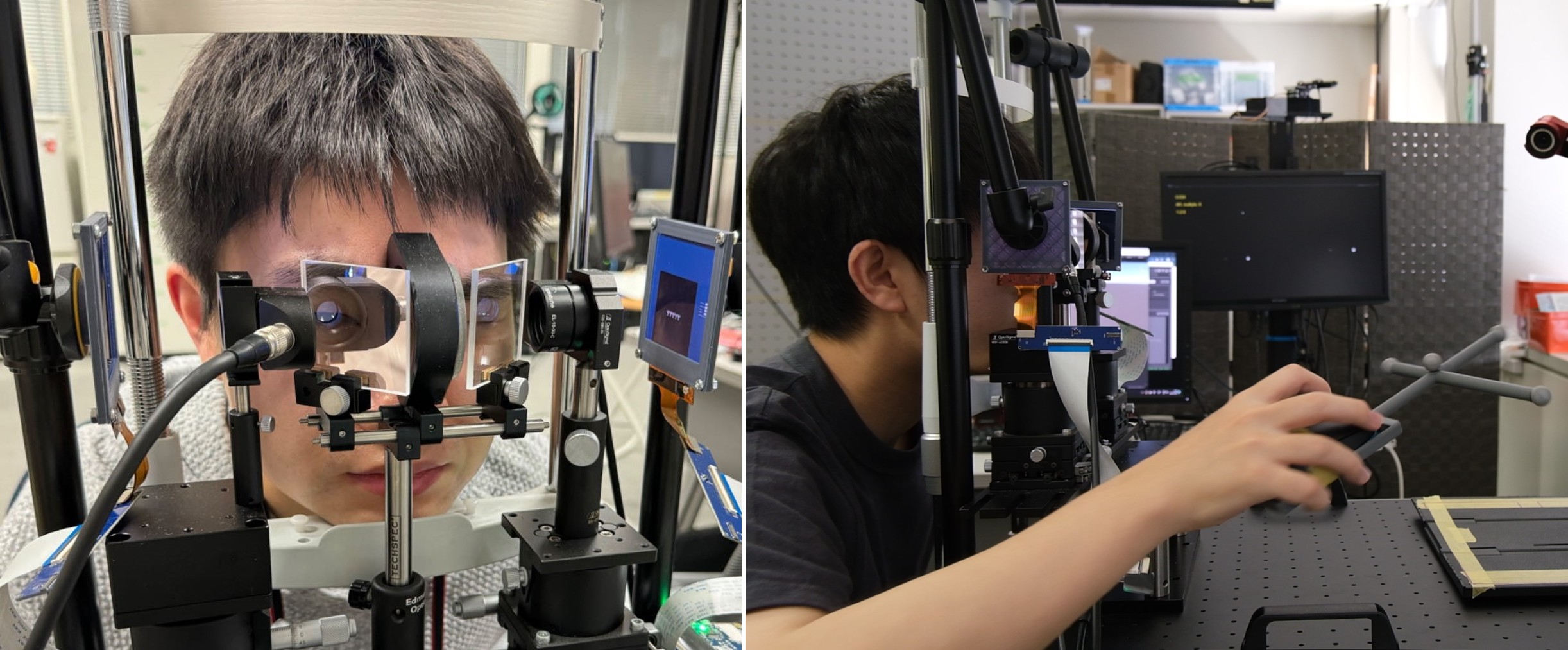
Participant conducting a 3D pointing task with the varifocal display
Abstract
This paper investigates whether a custom varifocal display can improve 3D pointing performance in augmented reality (AR), where the vergence-accommodation conflict (VAC) is known to impair interaction. Varifocal displays have been hypothesized to alleviate the VAC by dynamically matching the focal distance to the user’s gaze-defined target depth. Following prior work, we conducted a within-subject study with 24 participants performing an ISO 9241-411 pointing task under varifocal and fixed-focal viewing. Overall, varifocal viewing yielded significantly higher performance than the fixed-focal baseline across key interaction metrics, although the magnitude and even the direction of the benefit varied across individuals. In particular, participants' responses exhibited a baseline-dependent pattern, with smaller improvements (or occasional degradation) observed for those with better baseline performance. Our findings suggest that varifocal technology can improve AR pointing performance relative to fixed-focal viewing, while highlighting substantial individual differences that should be considered in design and evaluation.
Main Contributions
- A varifocal AR display tailored for evaluating mid-air interaction: Building on insights from prior VAC studies, we constructed a stereo AR varifocal display based on a validated design and optimized it for virtual hand pointing.
- A study of interaction with an AR varifocal display: We compare fixed-focal and varifocal modes and report performance outcomes across two study iterations, including a revised ergonomic setup to reduce potential performance constraints of the prototype. Results reveal interaction performance patterns consistent with VAC mitigation under varifocal viewing.
- Baseline-dependent effects of varifocal viewing: We observe that participants with better baseline performance under the fixed-focal condition tend to show smaller improvements under varifocal viewing, and in some cases even degraded performance. Other participants exhibited larger improvements in the varifocal condition.